How the coast divides up
Working north from the New Hampshire line, the Maine coast falls into five stretches that feel genuinely different from each other:
- The south coast: sand beaches, resort towns, the most people per mile of anywhere in the state.
- Greater Portland: the only real city on the coast, plus the lighthouse capes on either side of it.
- The midcoast: long peninsulas, working harbors, and the highest concentration of the postcard version of Maine.
- The Blue Hill peninsula and Deer Isle: quieter, artier, harder to get to, and the closest thing the coast has to a locals' secret.
- Mount Desert Island and Downeast: Acadia and its gateway towns, then a long empty stretch to the Canadian border.
One structural fact governs the whole thing: Route 1 runs roughly straight while the coast does not. The real shoreline is a comb of dead-end peninsulas, and the towns at the bottom of them are consistently quieter and better than the ones on the highway. Nearly every good decision you make on this coast involves turning off Route 1.
The south coast
Kittery is the first town over the bridge and the oldest incorporated town in Maine. Most people know it for the outlet strip on Route 1, which is a poor reason to stop. The reason to stop is Kittery Point, where Fort McClary State Historic Site (4.7 from 1,308 reviews) has a hexagonal blockhouse on the water and Fort Foster (4.7 from 694 reviews) gives you the best view of Portsmouth Harbor from a park most day-trippers drive past.
York is really four settlements with one name: York Village, York Harbor, York Beach and Cape Neddick. The famous stop is Sohier Park (4.8 from 1,321 reviews), the small headland facing the Nubble Lighthouse. Long Sands Beach (4.7 from 1,281) and Short Sands Beach (4.6 from 1,343) are the two swimming beaches, with Short Sands the more family-oriented and Long Sands the better walk.
Ogunquit is the most polished town on this stretch, a resort with a long-standing arts culture and a reputation as one of New England's most welcoming towns for LGBTQ travelers. The Ogunquit Playhouse (4.8 from 1,498 reviews) is the anchor, and the Marginal Way cliff path between the village and Perkins Cove is the best short walk on the southern coast. It is also densely packed in July and August, with parking that runs out early.
Wells is the quieter neighbor with seven miles of beach and the Rachel Carson refuge behind it. Kennebunkport and Kennebunk share the prettiest village center in the south (Dock Square) along with genuinely good beaches at Gooch's Beach (4.6 from 579 reviews) and Mother's Beach (4.6 from 477). Old Orchard Beach is the outlier: a pier, an amusement park, fried dough, and a long-standing Québécois summer crowd. It is unpretentious and unapologetic, and people who want a quiet Maine village should simply not go.
Greater Portland
Portland is the only place on the coast that functions as a city, and it is the easiest base for a first trip because you can day-trip in three directions from it. The Old Port's brick streets sit directly above a working waterfront, the restaurant scene is genuinely national-class, and the ferry terminal puts a half-dozen inhabited islands within twenty minutes. Bug Light Park (4.7 from 2,518 reviews) and the Portland Museum of Art (4.6 from 2,232) are the strongest non-food draws.
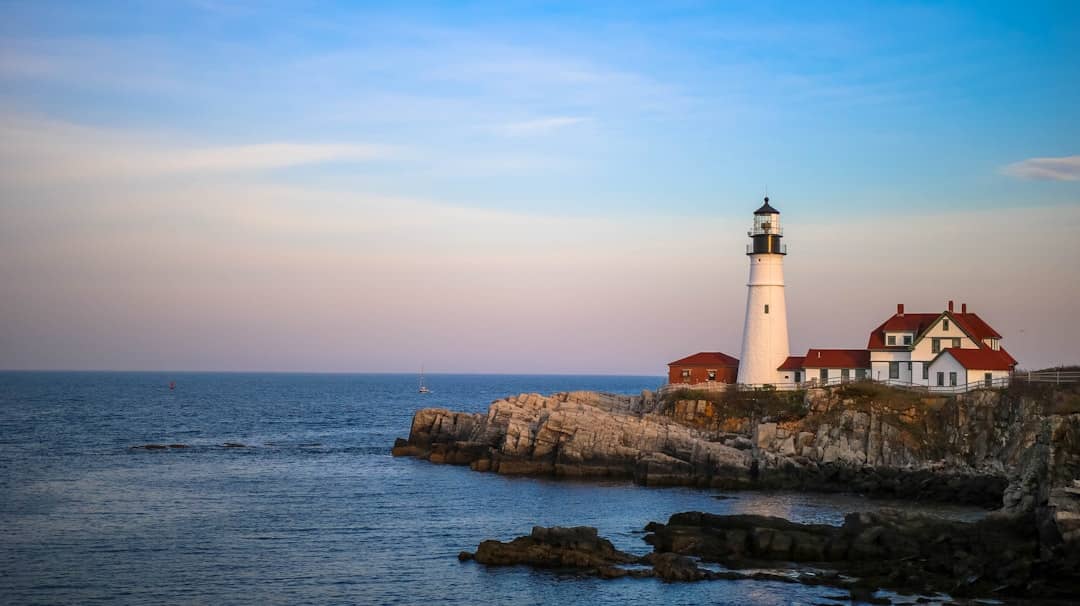
Cape Elizabeth, ten minutes south, holds Portland Head Light (4.8 from 16,744 reviews) (the most-reviewed lighthouse in the state by an enormous margin) inside Fort Williams Park (4.8 from 3,781). Two Lights State Park (4.7 from 1,578) is next door and much less crowded. Freeport, twenty minutes north, is an outlet town built around the L.L.Bean flagship, and the part worth your time is outside the shops: Wolfe's Neck Woods State Park (4.8 from 1,431 reviews) and the shorefront at Winslow Memorial Park.
The midcoast
If you only have time for one stretch of the Maine coast, take this one.
Bath is a shipbuilding town and still a working one, with a downtown of nineteenth-century brick and the Maine Maritime Museum on the river. Harpswell, just south, is three long peninsulas and a scatter of islands. The Bailey Island cribstone bridge is built of stacked granite slabs with no mortar, a design that exists nowhere else, and the Giant's Stairs shore path (4.7 from 532 reviews) is a short, excellent walk. Out at the end of the Phippsburg peninsula, Popham Beach State Park (4.8 from 2,104 reviews) is the most dramatic sand beach in the state.
Boothbay Harbor is a compact harbor village that fills to capacity in summer. Its outsized draw is the Coastal Maine Botanical Gardens (4.8 from 7,005 reviews), the most-reviewed attraction anywhere in the midcoast, and the peninsulas either side hold Pemaquid Point Lighthouse (4.8 from 3,243) and Reid State Park (4.8 from 1,563).
Damariscotta is a small river town that has quietly become the center of Maine's oyster industry, with a walkable main street and shell middens on the riverbank left by thousands of years of people eating the same thing you are about to. Nearby Fort Edgecomb (4.5 from 354 reviews) is a well-preserved octagonal blockhouse.
Rockland and Camden sit eight miles apart and are almost opposites. Rockland is a working harbor with an art town grafted on: the Farnsworth Art Museum and its Wyeth collection, the mile-long Rockland Breakwater out to its lighthouse (4.8 from 1,318 reviews), and the windjammer fleet. Camden is the picture (a harbor with mountains directly behind it) and Camden Hills State Park (4.7 from 2,069 reviews) puts you above the whole bay. Camden is prettier; Rockland has more going on and cheaper rooms.
Belfast, further up Penobscot Bay, spent the twentieth century as a poultry and shoe town and the twenty-first as an arts one. It has the least tourist-shaped downtown of any harbor town on this list, which is exactly why some people prefer it.
The Blue Hill peninsula and Deer Isle
This is where the coast gets quiet. Castine is a small college town (Maine Maritime Academy) on a peninsula that changed hands among the French, Dutch, British and Americans, and has one of the densest collections of pre-1800 houses in New England. Blue Hill is a village of potters, a summer chamber music school, and an agricultural fair that has been running for well over a century.
Across the bridge, Deer Isle holds the Haystack Mountain School of Crafts, and at the far end Stonington is a granite-quarrying town turned fishing port that regularly lands more lobster than anywhere else in Maine. It looks the way people imagine a Maine fishing village looks, and it is not performing for anyone. The catch: it is roughly an hour off Route 1 each way, restaurants are few and close early, and there is very little to do in the conventional sense. That is the point.
Mount Desert Island and Downeast
Bar Harbor is the gateway to Acadia and the busiest small town in Maine in August, with cruise ship days on top of everything else. Agamont Park (4.7 from 1,775 reviews) and the Shore Path give you the harbor; Cadillac Mountain (4.9 from 1,528) and Thunder Hole (4.6 from 3,222) are the park's headline stops. The island's west side (Southwest Harbor, Bass Harbor and Northeast Harbor) is locally called the quiet side and earns the name.
East of Ellsworth the coast empties out fast. Blueberry barrens replace boutiques, the working waterfronts stop being scenic and start being functional, and the drive gets long. At the far end, Lubec is the easternmost town in the United States, with West Quoddy Head Lighthouse (4.9 from 1,488 reviews) and Quoddy Head State Park (4.9 from 1,387). Two of the highest-rated places on the entire Maine coast. Eastport, across the bay, sits on a deep-water port beside the largest tidal whirlpool in the Western Hemisphere.
Getting between them
You will need a car for almost all of this. Route 1 is the coastal road and it is slow by design. It runs through the middle of every town rather than around it, which is pleasant in May and maddening in August. I-295 and I-95 parallel it inland and will save you an hour between Portland and Brunswick, at the cost of seeing nothing. The sensible pattern is highway for distance, Route 1 for the stretch you actually came to see.
Rough driving times, without summer traffic: Kittery to Portland, an hour. Portland to Camden, two hours. Camden to Bar Harbor, another two. Bar Harbor to Lubec, close to three, and it feels longer because there is nothing to break it up. Add fifty percent to any of those on a July Saturday.
Two alternatives to driving are worth knowing. Amtrak's Downeaster runs from Boston to Portland and on to Brunswick, which makes a car-free long weekend in Portland genuinely workable. And the ferries are public transport, not tours: Casco Bay Lines sails from Portland to a half-dozen inhabited islands including Peaks Island, and the state-run ferry service links Rockland to Vinalhaven and North Haven, Lincolnville to Islesboro, and Bass Harbor to Swan's Island. They run year round on published schedules and cost a fraction of a charter.
Which town for which trip
| Town | Region | Character | Best for | August crowds |
|---|
| Kittery | South coast | Working navy town with outlets | Forts, oysters, a first or last stop | Moderate |
| York | South coast | Four villages, two big beaches | Families, lighthouse photos | Heavy |
| Ogunquit | South coast | Polished arts resort | Theater, the Marginal Way, walkability | Very heavy |
| Kennebunkport | South coast | Postcard village, moneyed | Inns, beaches, dining | Heavy |
| Portland | Greater Portland | Small city, big food scene | Restaurants, islands, a base | Heavy but absorbable |
| Bath | Midcoast | Working shipbuilding town | Maritime history, beaches nearby | Light |
| Boothbay Harbor | Midcoast | Compact harbor village | Boat trips, botanical gardens | Very heavy |
| Damariscotta | Midcoast | River town, oyster capital | Eating, a quiet base | Light |
| Rockland | Midcoast | Working harbor plus art | Museums, schooners, value | Moderate |
| Camden | Midcoast | Harbor under mountains | The view, hiking, sailing | Heavy |
| Belfast | Midcoast | Unpolished arts town | Wandering, a real downtown | Light |
| Stonington | Deer Isle | Genuine fishing port | Islands, quiet, no agenda | Light |
| Bar Harbor | Mount Desert Island | Acadia gateway | The national park | Extreme |
| Lubec | Downeast | Easternmost town in the US | Lighthouses, tides, solitude | Very light |
Picking one
For a first trip with limited time, base in Portland or Camden and drive out from there. Both put a lot of coast within an hour. For a second trip, go to the midcoast peninsulas and stay put. For a trip where the point is not seeing things, go Downeast, where the drive is long, the towns are small, and nothing has been arranged for your benefit.
Two practical notes. Season matters more here than almost anywhere: many coastal restaurants, inns and boat operators close entirely between late October and late May, and a beautiful village in February can have nothing open at all. And traffic on Route 1 between Brunswick and Camden in July and August is genuinely bad, with Wiscasset the traditional bottleneck, build the extra hour into your planning rather than discovering it.
For the wider picture, see our guide to the Maine coast and our roundup of Maine's best small towns, which goes inland as well.
Frequently asked questions
What is the prettiest coastal town in Maine?
Camden gets the most votes, and reasonably so. It is the only harbor in the state with mountains rising directly behind it, and Camden Hills State Park (4.7 from 2,069 reviews) puts you above the whole of Penobscot Bay. Kennebunkport's Dock Square and Castine's historic district are the other two that consistently come up. If you want scenery without the crowds, Stonington on Deer Isle beats all three.
Which Maine coastal town is best to stay in?
Portland if you want restaurants, nightlife and easy day trips in three directions. Camden or Rockland if you want the midcoast within reach and a walkable harbor at the end of the day. Bar Harbor only if Acadia is the main event, since it is expensive and packed in season. Damariscotta and Belfast are the value picks, real towns with real downtowns and a fraction of the summer markup.
How many days do you need to see the Maine coast?
Five days gets you from Kittery to Bar Harbor without it feeling like a forced march, but you will be sampling rather than seeing. A week lets you add two or three peninsulas, which is where the coast actually lives. Anything under three days is best spent on one region. Pick greater Portland or the midcoast and skip the rest rather than driving past all of it.
What is the best time of year to visit Maine's coastal towns?
Early to mid-September. The water is at its warmest, the towns are still fully open, the summer crowds have gone and the light gets noticeably better. June is quiet and green but the ocean is cold and fog is common. July and August are the peak of everything, good and bad. From November through April a large share of coastal businesses simply close.