
Guide
Maine Fall Foliage: Coastal Itinerary and Regional Timing

For coastal Maine foliage, build a five-day trip around Portland, Camden and Acadia in October. Give Camden Hills and Acadia the outdoor days, with city and museum stops between them. The coast usually turns later than northern Maine; choose the coastal trip for the scenery as a whole, not a guaranteed peak date.
Updated September 2026
The main route is a five-day coastal trip, with Portland, a Midcoast base and Acadia doing different jobs. The western and northern drives later in the guide are alternatives for a trip centered on those regions. They are not extra mileage to add to every coastal day.
Use the regional timing as a typical window and the dated field report as a report from its stated day. Neither promises the color on a particular visit. That distinction makes the itinerary more useful: a museum, a harbor and a well-chosen outdoor block still give the day a purpose when one hillside is early or late. Choose the region you want to spend time in, then keep enough flexibility to put the outdoor portion in the best available part of the day.
For more trip planning, see Maine Foliage by Region: Seven Typical Windows.
When should a coastal foliage trip happen?
The state's foliage guidance places northern Maine's usual peak in late September to early October and the coast later, commonly in mid-to-late October. Portland, Camden and Kennebunkport fall in the southern/coastal reporting pattern; Bar Harbor belongs to the Downeast zone. Those are reporting regions, not guarantees for a particular tree or weekend. [1]
| Trip choice | Best reason to choose it | Main compromise |
|---|---|---|
| Coastal October route | Harbors, hills and autumn color together | Seasonal services begin closing |
| Earlier northern route | Northern foliage timing is the priority | It is a different trip from the coast |
| Portland and Camden only | Fewer transfers and a shorter break | Leave Acadia for another visit |
What should you do over five days?
Day 1: Portland's waterfront and city
Start in Portland's Old Port, then give the Arts District the second block. The city makes the arrival day useful without depending on a mountain view. The Portland itinerary provides the longer city version.
Day 2: Rockland art, then Camden
Move to Rockland for the Farnsworth and finish in Camden. In the museum's published October–December 2026 calendar it opens Wednesday–Monday, 10 a.m.–4 p.m., with listed holiday exceptions. Tuesday is the day to reverse the museum and outdoor blocks. [2]
Day 3: Camden Hills
Make Camden Hills the main outing. Mount Battie combines the harbor and Penobscot Bay view with the wooded hills, so the day still has a clear purpose outside a narrow peak-color window. Stay in the same Midcoast base rather than moving rooms after every outing. [3]
Day 4: Transfer to Bar Harbor
Travel onward and use Bar Harbor as the arrival-day destination. Leave the main Acadia outing for the following day. The Portland-to-Acadia guide explains why collecting peninsulas along the way changes the size of the trip.
Day 5: Acadia's pond and coast
Choose Jordan Pond and the ocean side of Acadia, rather than adding a separate Schoodic transfer. The October guide separates foliage timing from service calendars. Island Explorer's main 2026 season ends October 12, while Cadillac vehicle reservations continue through October 25. Those dates do not move together. [4] [5]
What should you skip on a shorter foliage trip?
For three days, keep Portland and Camden and omit Acadia. For five days without a car, choose the Portland city-and-ferry version instead of treating seasonal park buses as a statewide transport network. The foliage tool supplies regional context; it is not a promise of an exact peak date. Skip the cross-state chase for a supposedly perfect tree and keep the outdoor and cultural halves of the chosen route intact.
What other planning questions does this route raise?
Is early October always the best week on the Maine coast?
No. Coastal foliage generally runs later than the northern interior. This route is worthwhile for its harbors, hills and park scenery across the October window, not just on a single predicted peak day.
What should you remove from a three-day coastal foliage trip?
Remove Acadia and keep Portland plus Camden. That preserves a city day and a substantial hill-and-harbor day without spending the break on repeated transfers.
Sources (checked September 27–28, 2026)
- maine.gov — Seasonal progression; Foliage Zones1–7; September23,2026 report; checked 2026-09-27.
- farnsworthmuseum.org — 2026 museum hours, admission and restoration closures; checked 2026-09-27.
- maine.gov — Mount Battie and park geography; checked 2026-09-27.
- exploreacadia.com — 2026 Service Calendar; checked 2026-09-27.
- nps.gov — 2026 reservation dates; release windows; pass distinction; QR code; checked 2026-09-27.
Maine in the fall is a moving target. Color starts in Aroostook County in the third week of September and finishes in the York County oak woods in late October, which means there is no single right week to come. Only a right week for the part of the state you have chosen. This guide maps that progression against real places, with the drives, overlooks and bookings that matter.
How the season actually moves
Fall color in Maine runs roughly north to south and inland to coast, and both of those matter. The state spans about three and a half degrees of latitude, and the difference between the top and the bottom is close to a month of leaf change. Layered on top of that, the ocean holds heat: coastal towns turn a week or so later than inland towns at the same latitude, and the outer islands later still.
The usual pattern, in broad strokes:
- Third and fourth weeks of September: Aroostook County, the Moosehead region, the Katahdin area. Birch and maple go first; the spruce and fir stay dark green all season, which is why northern Maine reads as splashes of color in a green matrix rather than a solid wall of it.
- The first two weeks of October: the western mountains: Rangeley, Weld, Bethel, the Grafton Notch corridor. This is the strongest week-for-week color in the state, and the reason the western Maine lodging market sells out first.
- Mid-October: the midcoast, the Belgrade and Sebago lakes, Acadia. Peak here usually overlaps with the second and third weekends of the month.
- Late October: southern Maine and the immediate coast, where oaks hold on and turn a deep russet after the maples have dropped.
Maine's forestry department publishes a weekly foliage condition map through the season. Use it, but use it as a nowcast rather than a forecast: it tells you what turned last week, not what will turn next week.
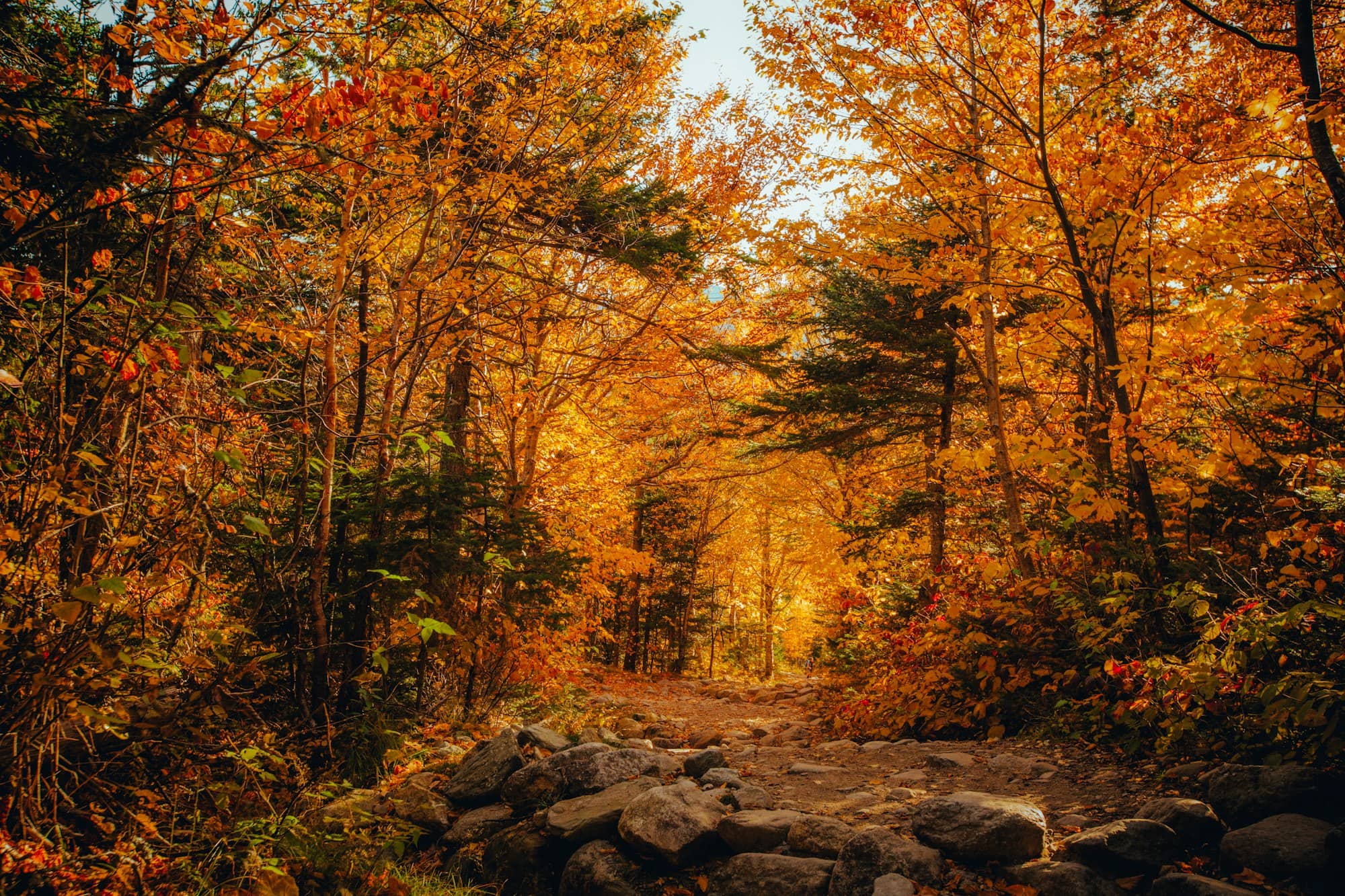
The species mix explains a lot of what you see. Sugar and red maple supply the oranges and the hard reds and go early. Birch, beech and aspen give the yellows that dominate the middle of the season. Northern red oak, concentrated in the south and along the coast, turns a deep brick red last and hangs on longest. And through the northern half of the state, spruce and fir never change at all, which is why photographs from Aroostook and Moosehead show color scattered through dark evergreen rather than the unbroken sheets of the White Mountains. Neither is better; they are different pictures, and it is worth knowing which one you are driving toward.
Foliage by latitude: where to be, and when
Rather than a vague map, here is the progression pinned to real places, ordered by their actual latitude in our dataset. Ratings and review counts are from the same data.
| Place | Town | Latitude | Rating | Reviews | Usual peak |
|---|---|---|---|---|---|
| Aroostook State Park | Presque Isle | 46.6°N | 4.8 | 300 | Third week of September |
| Lily Bay State Park | Beaver Cove, on Moosehead | 45.6°N | 4.8 | 460 | Late September |
| Peaks-Kenny State Park | Dover-Foxcroft | 45.3°N | 4.8 | 439 | Late September |
| Mt. Blue State Park | Weld | 44.7°N | 4.7 | 532 | First week of October |
| Grafton Notch State Park | Newry | 44.6°N | 4.8 | 1,069 | First to second week of October |
| Acadia National Park | Mount Desert Island | 44.3°N | 4.9 | 24,003 | Mid-October |
| Camden Hills State Park | Camden | 44.2°N | 4.7 | 2,069 | Mid-October |
| Sebago Lake State Park Campground | Naples | 43.9°N | 4.6 | 1,592 | Mid-October |
| Wolfe's Neck Woods State Park | Freeport | 43.8°N | 4.8 | 1,431 | Mid to late October |
| Vaughan Woods State Park | South Berwick | 43.2°N | 4.7 | 322 | Late October |
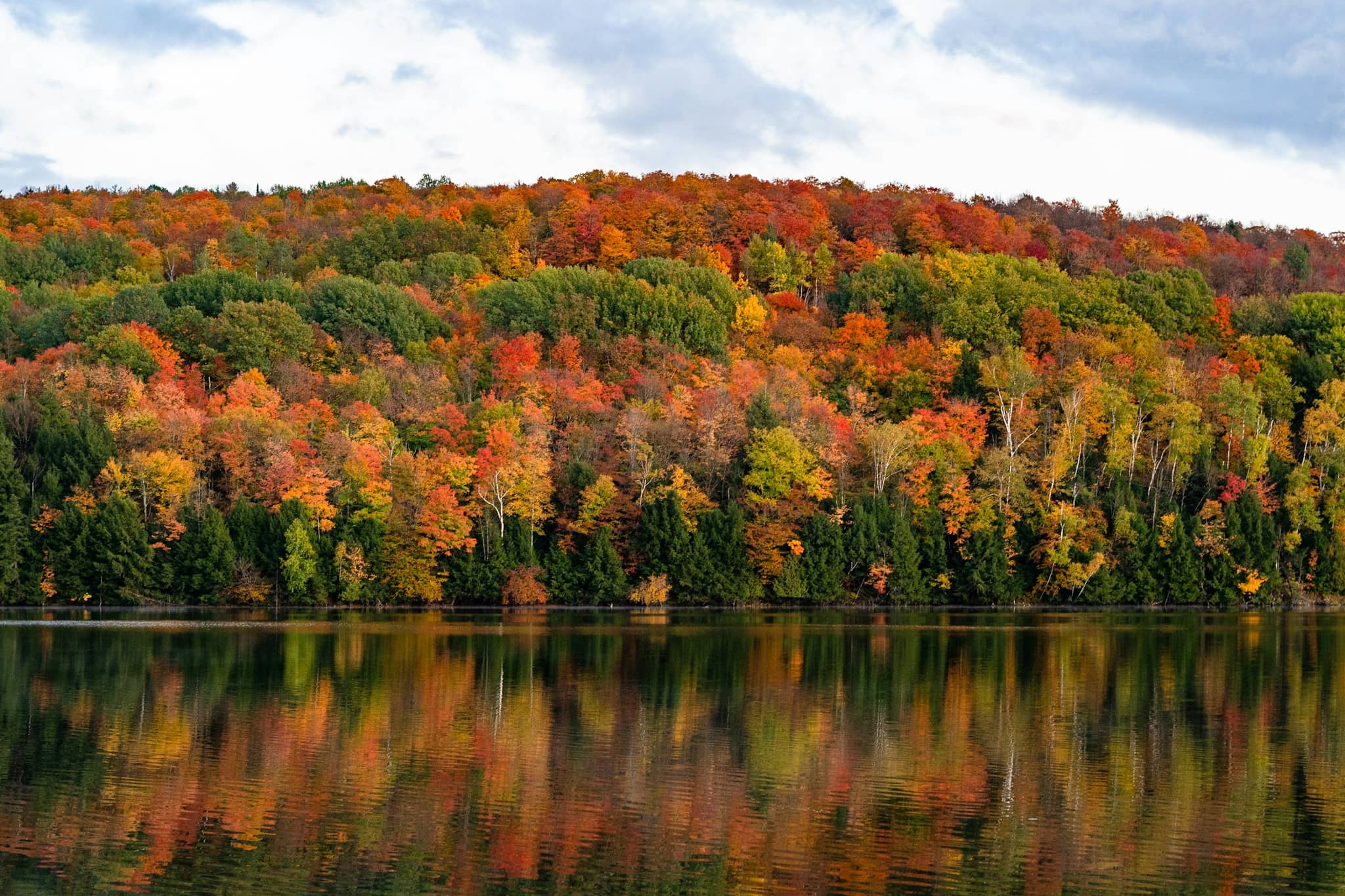
Notice Acadia and Camden Hills sitting later than Grafton Notch despite being only a fraction of a degree further south. That is the ocean effect, and it is the single most useful thing to know about planning a Maine leaf trip: if you have missed peak in the mountains, drive to the coast and you have probably bought yourself another week.
The drives
Foliage in Maine is a driving activity more than a hiking one, because the good stuff is spread across a big, empty state. Four routes are worth the fuel.
| Route | Rough run | What you stop for | Best window |
|---|---|---|---|
| Route 17 and Route 4, the Rangeley loop | A long half day from Rumford | Height of Land, Rangeley Lake, Coos Canyon | Late September to first week of October |
| Route 26 through Grafton Notch | Under an hour of driving, half a day with stops | Screw Auger Falls, Table Rock, Step Falls | First two weeks of October |
| Park Loop Road, Acadia | Half a day | Cadillac Mountain, Jordan Pond, Otter Cliff | Mid-October |
| Route 1, Belfast to Bucksport and inland | Half a day | Penobscot Narrows Observatory, Moose Point, Fort Knox | Mid-October |
The Rangeley loop is the one to pick if you can only do one. Height of Land, the pull-off on Route 17 above Mooselookmeguntic Lake, is the most photographed foliage view in Maine for good reason: a mountain-ringed lake basin with no development in the frame. It has a proper parking area and a stone terrace, and on a peak-weekend afternoon it is bumper to bumper. Go early. Continue to Rangeley for lunch and loop back on Route 4.
Grafton Notch packs three waterfalls and a first-rate ledge view into nine miles of Route 26. The details are in our Grafton Notch guide. The park rates 4.8 from 1,069 reviews and it is the best value-per-mile foliage drive in the state.
Acadia's Park Loop Road is the coastal counterpart and the busiest. Cadillac Mountain (4.9 from 1,528) needs a vehicle reservation for the summit road in season, released on a rolling window through recreation.gov, and October reservations go fast. Everything else on the loop is first-come. See our Acadia hub for the full logistics.
The Penobscot Bay run is the underrated one. Fort Knox and the Penobscot Narrows Observatory (4.8 from 3,270) puts you in a glass box hundreds of feet above the river, which is the only elevator-assisted foliage view in Maine and a genuine gift on a day when you do not want to climb anything.
Getting above the trees
Color reads better from height. Maine's foliage overlooks divide neatly into ones you drive and ones you earn.
Mt. Battie in Camden Hills State Park (park: 4.7 from 2,069; the summit tower: 4.8 from 819) has an auto road to the top and a stone tower looking down on Camden harbor, Penobscot Bay and the islands. It is the best effort-to-payoff ratio on the coast, and in mid-October the hillside below the tower is the shot everyone comes for. Our Camden Hills hiking guide covers the walking routes up if you would rather not drive.
Bradbury Mountain State Park in Pownal (4.7 from 1,318) is twenty-five minutes from Portland and the summit is a fifteen-minute walk. For a family with young children and one usable afternoon, this is the answer.
Mount Agamenticus in York (4.8 from 897) is the southern equivalent: a low summit with an access road, a view to the Presidentials on a clear day, and a peak that arrives when everywhere else has finished.
Mt. Blue State Park in Weld (4.7 from 532) is the western-mountain pick that is not Grafton Notch, with Webb Lake reflecting the ridges around it. It is quieter than Rangeley on the same weekend.
The ski resorts are the wild card. Sunday River in Newry (4.6 from 3,081) sometimes runs scenic lift rides in the autumn, which buys you a summit view with no climb at all, but the schedule varies year to year, so confirm before you build a day around it.
Short walks that pay off in October
If you would rather be in the leaves than looking at them from a pull-off, four walks give a lot back for the time:
- Beehive Trail, Acadia (4.9 from 583): iron rungs and exposed ledge above Sand Beach, with the color running down to the water. Not for anyone uneasy with heights, and a bad idea in wet leaves.
- Ocean Path, Acadia (4.8 from 484): the shorter-walk alternative on the same stretch of coast, with uneven surfaces and stairs on the longer route, running past Thunder Hole (4.6 from 3,222) on a wide gravel path.
- Bald Mountain Preserve, Camden (4.9 from 103). A short steep climb to open ledge over Penobscot Bay, and far quieter than Mt. Battie on the same afternoon.
- Bangor City Forest (4.8 from 838). Flat, wide, boardwalked in places, and a genuinely good hour if you are passing through inland Maine and want a leg-stretch that is not a mountain.
Wet fallen leaves on granite are more slippery than they look, and October daylight shortens fast, by the end of the month the light is going by five. Carry a headlamp on anything longer than an hour.
What else fall does well
The leaves are the headline, but the season fixes several things that are wrong with a Maine summer. Black flies and mosquitoes are gone. Trailhead parking that overflows in August has room in October. Swimming remains a separate decision based on water conditions and the group; a foliage calendar does not establish a safe or comfortable water temperature. Oysters and lobster are both good, and the harvest end of the food calendar (apples, cider, squash, the last of the corn) is at its best.
Agricultural fairs run through September across the state, and pick-your-own orchards cluster in the inland counties west of Portland. Coastal Maine Botanical Gardens in Boothbay (4.8 from 7,005) puts on a substantial fall program and is one of the few places in the state where the landscaping is designed for the season rather than simply responding to it.
For a broader month-by-month view of what is open and what is not, see our October guide, and the Maine road trip itinerary if you want to string several regions together.
The honest part
Four things nobody selling you a foliage tour will lead with.
Peak is unpredictable and short. The window at any given spot is about a week to ten days, and it moves by up to two weeks year to year depending on summer rainfall, night temperatures and when the first hard frost lands. A drought summer produces early, dull, fast-dropping color. Book a region, not a weekend.
One storm ends it. A single windy rainstorm at the wrong moment strips a hillside in a day. There is no insurance against this beyond flexibility.
Lodging is at its most expensive and least available. October rates in Bar Harbor, Camden and the Bethel valley match or beat August, and the good places book months out. If you are deciding late, look inland. Dover-Foxcroft, Greenville, Weld and Rumford all have capacity when the coast has none.
Things start closing. Seasonal restaurants, ferries and lobster shacks begin shutting from mid-October, and by early November much of the coastal tourist infrastructure is dark. The color is still good in the second half of the month; the services around it are thinning fast.
Seasonal planning update
Maine DACF’s report dated September 9, 2026 lists very low color change and leaf drop in all seven reporting zones. This is the agency’s dated report, not a live field observation by Maine.com. Check the weekly report before choosing a route.
Source: Maine DACF foliage report · Source date 2026-09-09 · Checked 2026-09-16
Sources: 2026-09-14 — Maine Forest Service foliage report, regional timing guidance, southern-region foliage places and NPS Cadillac reservations.
Frequently asked questions
When is the best time to see fall foliage in Maine?
It depends where you go. Northern Maine and the Moosehead region peak in the last week of September, the western mountains around Rangeley and Bethel in the first week or two of October, the midcoast and Acadia in mid-October, and southern Maine in the last week of the month. If you want one date that works for the largest share of the state, the second weekend of October is the safest bet.
Where is the best foliage view in Maine?
Height of Land on Route 17 above Mooselookmeguntic Lake is the consensus choice: a broad, undeveloped lake basin ringed by mountains, with a proper pull-off. For a view you can reach without a hike on the coast, Mt. Battie in Camden Hills State Park, which rates 4.7 from 2,069 reviews, has an auto road and a stone tower over Penobscot Bay.
Is Acadia National Park good for fall foliage?
Yes, and it peaks later than the rest of the state because the ocean keeps the island warm. Usually mid-October. The combination of red maple against granite and blue water is unlike anywhere inland. The tradeoff is crowds: October weekends rival July, the Cadillac summit road requires a vehicle reservation in season, and popular trailheads fill early.
How long should a Maine fall foliage trip be?
The main coastal itinerary here uses five full days. With three days, keep Portland and Camden and leave Acadia out. A western-mountain foliage trip is a different regional choice, with its own time rather than an extra cross-state segment attached to the coastal plan.
Related planning guides: Things to Do in Rangeley, Maine: Lakes or Snow?; Maine in September: Coast, Cities and Regional Choices; Maine Scenic Drives: Choose Coast, Lakes or Mountains.